
HEAL - Hubs of Expressive Arts for Life to Prevent and Address Family Violence
Access Alliance Multicultural Health and Community Services (Access Alliance) works with peer researchers, community members, and academic and community organization partners to implement the HEAL Project. It is an inter-sectoral, creative, culturally safe, multi-pronged capacity-enriching project. This co-design, mixed method, community-based participation action research is focused on newcomer women survivors of GBV in the City of Toronto. HEAL Project Webpage.
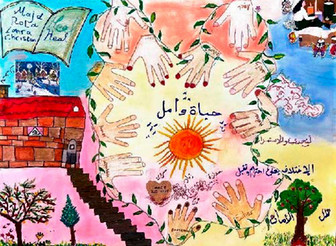
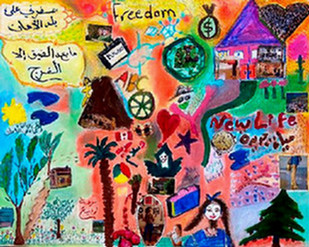
Collective paintings created by the HEAL Arabic-speaking group. Check out our HEAL Project Webpage.
Images: collective paintings created by the Arabic speaking HEAL Group. Left titled “New Beginnings Together”. Right titled, “Journey to Safety”.
Project Activities Overview
Year 1: Adaption and Intervention Planning
The Research and Evaluation project team conducted a literature review, and environmental scan followed by facilitating co-design sessions to identify existing art-based practices for newcomer gender-based violence individuals. Foundational learnings informed the development of the 12-session HEAL intervention Program, using expressive arts practice to improve the mental well-being of newcomer women survivors of GBV.
• Year 1 Milestone Report
• HEAL Project Overview
• The 5th Metropolis Co-Design Report
• HEAL Co-Create Session Report
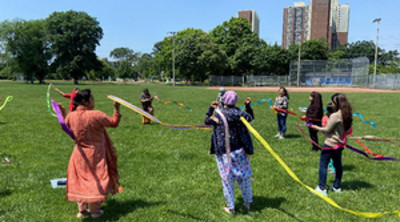
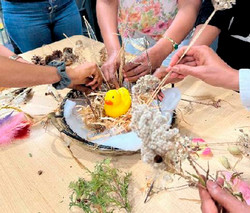
Images: left, Bengali speaking HEAL Group engaging in dance ribbon activity to learn about somatic resourcing as an approach to self a co-regulation. Right Tigrinya speaking HEAL Group co-creating a safe, trusting, and secure nest to establish group guidelines at the beginning of the program.
Year 2: Program Implementation & Data Collection
The implementation of PHASE 1 HEAL program completed including: Arabic, Bengali, and Farsi speaking newcomer groups. Data collection is woven into program design measuring mental health, knowledge and behaviour indicators.
• Year 2 Milestone Report
• Related Blog Post “Reimagining Home: Improving Newcomer Mental Wellbeing through Art”
• Policy Scan: Canadian Policies & Initiatives on Gender Based Violence
• Infographic: Gender-Based Violence & Newcomer Perspectives
Year 3: Program Implementation & Data Analysis
The implementation of the PHASE 2 HEAL program has been completed, including Tigrinya-speaking, LGBTQ+, and newcomer women with previous shelter experiences. The data collected, both qualitative and quantitative, is continuously being analysed and validated by facilitation and community members.
• Year 3 Milestone Report
• Publication Snapshot Implementation Research with Expressive Arts Therapy (EAT) to Support the Newcomer Survivors of Gender-based Domestic Violence (GBDV) in Toronto. Proceedings of the 7th International Conference on Gender Research, Vol 7, No 1, 2024.
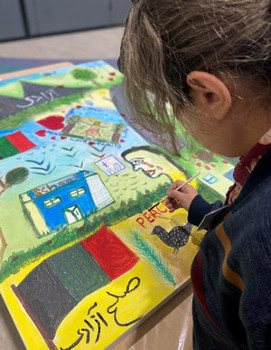
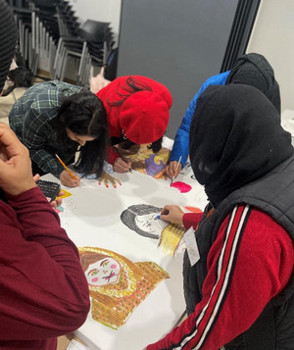
Images: Participants from the Farsi speaking HEAL Group collectively producing the collective paintings.
Year 4: Knowledge Mobilization & Hubs for Professional Development
The HEAL team has synthesized the findings and created various knowledge products for a range of audiences using diverse dissemination platforms. The HEAL Project will evolve to become a space for multisector partners to network, exchange information and resources, and collaborate on new Expressive Arts projects.
Arts for Family Health offers a digital platform to learn about arts-based health promotion approaches. This platform offers resources and tools designed for practitioners, managers, researchers, and academics interested in integrating creative methods into their work. Discover how to navigate the digital platform on best practices for delivering expressive arts programs that are inclusive, culturally responsive, and trauma-informed in this webinar recording.
The HEAL project was featured in an LNandKH webinar on July 10, 2025 on the use of arts for healing when working with immigrant and refugee families. You can view the recording here: Arts for Creative Healing Communities: Gender-based Violence Work and Prevention with Immigrant and Refugee Families.
A special event: Healing Arts for Newcomer Family Well-being was hosted by Access Alliance on November 12, 2025 at Toronto Public Library. This interactive evening guided participants through an artful experience exploring how creative expression can help address and prevent family violence, with a special focus on supporting newcomer women survivors of gender-based violence.

Community of Practice members:
Dr. Akm Alamgir

Akm Alamgir earned a Ph.D. degree in evaluation, a Master's degree in epidemiology, and a Bachelor's in medicine. He is the Director of Knowledge & Learning at Access Alliance (Toronto), an Adjunct Professor at York University (Toronto), and an Academic Editor of the scientific journal PLOS One. He is a mixed-method community-based researcher on social determinants of health in Canada (ORCID #0000-0003-4804-6609). He generates knowledge, creates learning materials, and builds the capacity of the stakeholders. He is the principal investigator of funded research projects on refugees, youth, mental health, and gender-based domestic violence. He is part of preparing the Canadian national standards in Youth Mental Health and Addictions Navigation Services. He is an “expert reviewer” of the Canadian government for the New Frontiers in Research Fund Transformation Competition (NFRFT 2022) applications. He reviews manuscripts submitted to the Journal of International Migration and Integration, PLOS One, and Health Promotion International.
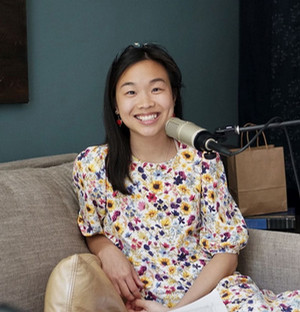
Christen Kong earned a Master of Social Work specialization in Human Service Management and Leadership and is a Registered Social Worker (843177). She is a Health Promoter at Access Alliance focusing on art-based practices and activities to improve the health outcomes of newcomer populationsin Toronto. She is the project coordinator for Hubs of Expressive Arts for Life –HEAL Project, a multi-year intersectoral implementation communitybased participatory research study on newcomer women survivors of domestic based violence. She is a member of multiple working groups and advisory committees to further the work of women against gender based violence. She is a placement supervisorand has been a field instructor for students in a variety of disciplines including students from Health in Community, Public Policy, Human Biology and Master of Social Work departments from different universities in Toronto.